
Liberica coffee brewing: Mastering bean density and natural sweetness
Baristas who are highly skilled with Arabica may still find themselves struggling when faced with specialty Liberica coffee, simply because an insufficient understanding of the bean’s “body language” is not enough. Brewing Liberica coffee is a dialogue with a massive, porous, and sugar-rich biological structure. To unlock its vibrant tropical fruit notes without triggering unwanted woody or smoky flavors, we must recalibrate the fundamental extraction variables.
I. Why can Arabica brewing recipes fail with Liberica?
To brew Liberica properly, one must first understand the material being handled. Unlike Arabica coffee, which has high density and a compact structure, or Robusta, which contains a high level of total dissolved solids, Coffea liberica possesses a distinct set of physical characteristics:
- Bean size & Morphology: Liberica beans are extremely large, often asymmetrical, and significantly longer. This poses challenges for conventional grinders in producing a uniform grind size.
- Bean density & Porosity: Despite having thick silverskin and husk layers, the green core of Liberica beans is often more porous than high-altitude Arabica beans. This porosity allows water to penetrate the bean structure more rapidly, resulting in a faster extraction rate.
- Sugar content: Liberica is renowned for its high natural sugar content (due to its extended ripening period of 7-9 months). Without proper control of temperature and brew time, these sugars can easily transform into harsh bitterness rather than fruity sweetness.


So what is the consequence? If you apply a standard Arabica pour-over recipe (fine grind, high temperature at 98°C, long brew time) to Liberica, you are very likely to encounter over-extraction. The result is a cup dominated by aggressive woody flavors, stripping away the floral and fruity delicacy.
II. How to fine-tune temperature and grind size when brewing Liberica?
To successfully extract Liberica coffee, especially at the extremely light roast levels pursued by XLIII Coffee, the guiding principle is: “Open the path for aroma, block the path for wood”.
A coarser grind is the key
Due to its porous, water-absorbent structure, Liberica requires a coarser grind than Arabica for the same brewing method.
A coarser grind reduces surface contact area, slowing down the dissolution of bitter compounds commonly found in the woody layers of this varietal.
At the same time, coarser grinding helps prevent clogging, as Liberica beans tend to produce excessive fines during grinding due to their asymmetrical structure.


Water temperature should sit at a balanced range: 88°C – 96°C
Temperature is a decisive factor for the survival of fruit-forward aromas in specialty coffees like Liberica:
-
92°C – 96°C: Suitable for initiating extraction, dissolving organic acids responsible for bright acidity (if present) and floral aromas.
-
88°C – 92°C: This is the safe temperature zone to extract sweetness without “burning” flavors. Using boiling water (100°C) risks denaturing Liberica’s high natural sugar content, producing scorched or astringent aftertastes.
Extracting Liberica is an art of restraint. We grind coarser to slow physical extraction and lower water temperature slightly to protect the chemical structure of sugars and fruit aromatics. When these two variables meet at equilibrium, Liberica sheds its rugged exterior and reveals a surprisingly elegant core.
III. Can cold brew turn Liberica into a “fruit wine”?
If pour-over demands high technical precision, cold brew may be the stage where Liberica truly shines. It is the optimal method to honor the biological characteristics of this species.
Why is Cold Brew ideal for Liberica specialty coffee?
- Low acidity and high sugar: Liberica naturally has lower acidity than Arabica. Cold extraction slows oxidation, minimizing the extraction of sharp acidic compounds and bitterness from caffeine (which is already relatively low in Liberica).
- Fermentation-like effect: With an immersion time of up to ~16 hours, Liberica has sufficient time to release its full sugar content and ester-based aromatic compounds (ripe jackfruit, mango, banana, etc.).


Liberica Cold Brew recipe
-
Ratio: 1:10 to 1:12 (e.g., 100 g coffee to 1,000-1,200 ml water). This concentrated ratio highlights Liberica’s signature full body.
-
Grind size: Extra coarse, similar to large sea salt crystals.
-
Water temperature: Filtered water at room temperature or cool (approximately 20°C -25°C).
-
Brew time: 14-16 hours, sealed and refrigerated.
-
Filtration: Filter through paper or muslin cloth. Serve over large ice cubes (ice balls). You may immediately notice an intense aroma of ripe jackfruit, followed by deep dark chocolate sweetness and a clean, low-acidity finish.

The resulting Liberica cold brew goes far beyond an ordinary coffee beverage.
It becomes a drink with full body, profound sweetness, and intoxicating aromatics, reminiscent of fruit wine or aged rum – an experience nearly impossible for Arabica or Robusta to replicate.
IV. Why you should experience Liberica directly at XLIII Coffee?
Despite clear theory, brewing or extracting Liberica at home remains a major challenge primarily due to equipment limitations.
First, a specialized grinder is essential. Liberica beans are so large that they often jam household grinders or cause unstable grinding (popcorning), leading to inconsistent particle size. At professional specialty cafés like XLIII Coffee, we use precision industrial grinders (such as the Mahlkönig EK43/E80) to ensure uniformity.

Second, water flow control during extraction is another critical challenge.
In pour-over brewing, guiding water evenly through Liberica’s porous coffee bed, neither too fast (resulting in weak cups) nor too slow (causing bitterness) requires the skill of well-trained baristas.
At XLIII Coffee, every batch of Liberica is the result of meticulous research and variable calibration. We invite you to experience a properly extracted cup of Liberica where aroma and natural sweetness converge in perfect structure. Each brewing method acts as a different lens through which its beauty is revealed:
Filter/Pour-over – Transparency of Floral Aromas
Using a V60 with pulse pouring, this method highlights clarity and hidden white-floral notes in extremely light-roasted Liberica. You may be surprised by its cleanliness, gentle acidity, and subtle jasmine or pomelo blossom aromas – qualities many assume Liberica cannot possess.


Shot/Espresso – The explosion of body & syrup
Liberica espresso is extracted at stable 9-bar pressure. Due to its high sugar and dissolved solids, the shot is served without crema yet retains a syrup-like viscosity. Expect deep sweetness, intense spice and aromatic wood notes, and an endlessly lingering finish.
Milk-based/Latte – The “Jackfruit Smoothie” surprise
Combining Liberica espresso with oat milk creates one of the most unexpected pairings. The milk’s creaminess amplifies Liberica’s tropical fruit notes, producing flavors reminiscent of jackfruit smoothie or banana ice cream. Bitterness and astringency disappear entirely, replaced by rich sweetness and aroma making this the perfect gateway into Liberica.
It can be said that,
Liberica is not a “second-tier substitute.” When its structure is understood and treated correctly through scientific extraction methods, it becomes a treasure trove of flavor waiting to be awakened.
Images are owned by XLIII Coffee and curated from Dark House Company, Fork in the Kitchen, and Perfetto.
V. FAQs
1. Is Liberica really bitter and astringent as rumored?
Not at all. Bitterness and astringency usually stem from overly dark roasting or poor processing in the past. Specialty Liberica at XLIII Coffee is roasted extremely light and carefully processed, delivering fruity sweetness and gentle acidity.
2. With such low caffeine, does Liberica still help me stay alert?
Liberica contains less caffeine than Arabica (~1.23 g/100 g), producing a smooth, sustained alertness rather than jitters or heart palpitations, ideal for focused afternoon work.
3. Can Liberica be brewed using a Vietnamese phin filter?
Yes. Liberica’s porous structure and bold flavor pair well with the phin’s slow percolation. Just remember to use water below boiling (around 90-92°C) to preserve sweetness.
4. Why is Liberica often called “Jackfruit Coffee”?
The name comes from its distinctive aroma. Due to its long sugar accumulation period (nearly one year), Liberica releases ester compounds reminiscent of ripe jackfruit, banana, or mango.
5. Is Liberica better hot or cold?
It depends on your preference. Hot highlights floral aromas and clarity; cold amplifies fermented fruit flavors and body. We recommend trying both to witness its remarkable transformation.

Bài viết mới

- Taste the Origin
Rift Valley Coffee Caucus #03757 – A Testament to Western Kenya’s Collective Spirit
Turning our gaze to the Great Rift Valley of East Africa, the fertile volcanic landscapes are witnessing an inspiring transformation. Moving away from fierce, survival-driven competition, smallholder farmers in Western Kenya have chosen to join forces, forging a resilient and unified network. The Rift Valley Coffee Caucus #03757 lot stands as the ultimate testament to this remarkable collective synergy.

- Breaking News
Airworks Coffee & XLIII Coffee – A “handshake” that brings original flavors across borders
XLIII Coffee, alongside our key wholesale partner Airworks Coffee, officially announces the latest release of specialty coffee lots for the North American market. This event reaffirms our commitment to bringing original flavors across all geographical barriers to coffee enthusiasts.
Early access (for Subscribers of Airworks): 10:00 AM (PST) | Wednesday, April 29, 2026
General access: 10:00 AM (PST) | Friday, May 1, 2026
We invite our Customers and Partners to visit (airworkscoffee.com) for detailed information and to prepare for this special release!
- Taste the Origin
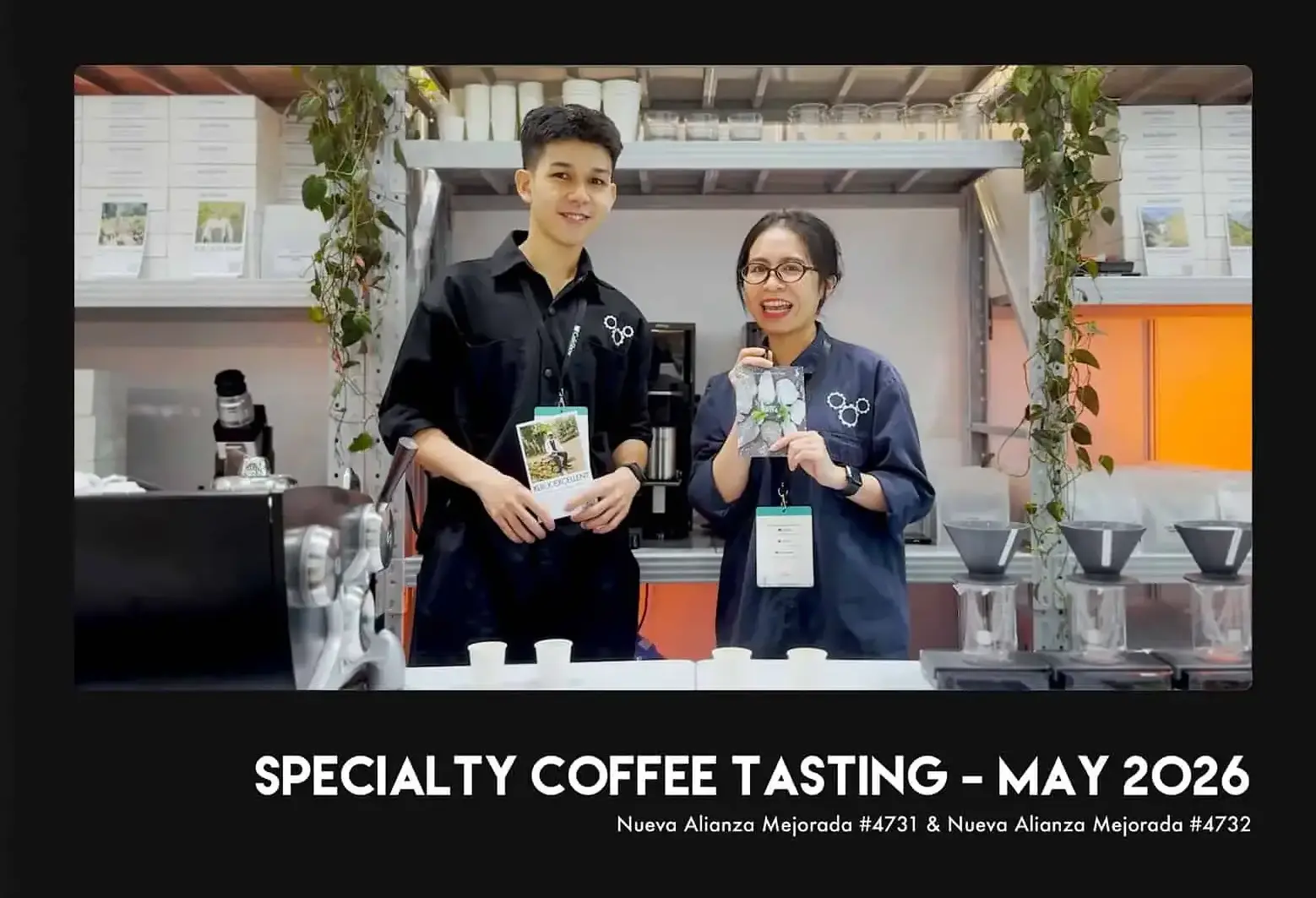
Unveiling May Discovery Subscription: Nueva Alianza Mejorada #4731 & Nueva Alianza Mejorada #4732
The Discovery Subscription is a silent dialogue, a place where the soul of the connoisseur finds a harmonious beat with distant lands. Like a transparent lens, we become storytellers, meticulously peeling back layers of cultural sediment, the breath of the soil, and the human philosophies hidden within every coffee bean.
May arrives with brilliant streaks of golden sunlight, a time when we long to hide beneath the lush, dew-drenched canopies of Santa Teresa. Amidst the silence of the Andes, when compassion touches Mother Earth, what will we hear? Perhaps it is a sweet response that nature reserves solely for souls who know how to wait patiently.

- Taste the Origin
Nueva Alianza Pacamara #4733 – The essence of Cusco with elegant jasmine notes
Nueva Alianza Pacamara #4733 is a testament to the miraculous terroir and dedicated cultivation of the renowned Cusco region. The combination of the characteristic Pacamara bean size and ideal altitude has forged a flavor profile of immense sophistication and depth. From the very first moment, this lot captivates with its elegant jasmine notes, radiating a gentle, pure fragrance akin to a flower blooming in the morning dew.

- Taste the Origin
Nueva Alianza Orange Gesha #4737 – An expedition of recessive genetic traits into the sensory realm
In a world of authenticity, Nueva Alianza Orange Gesha #4737 represents the proud emergence of rare biological traits often obscured by nature’s universality. Carrying a recessive genetic code, Lot #4737 embarks on an “expedition” into the connoisseur’s mind, where record-breaking fructose concentrations are released to perfectly fill every sensory gap with absolute smoothness and purity.
Through washed processing and extremely-light roasting, vibrant citrus nuances and ethereal floral notes, once hidden deep within the genetic structure, now manifest with power, transforming the tasting experience into a journey of ontological completion, where the rarity of recessive genes finally reigns supreme in flavor.

- Taste the Origin
Nueva Alianza Maragogipe #4735 – The “Giant” at the center of attention
Amidst a world of countless specialty coffee beans, Nueva Alianza Maragogipe #4735 emerges as a symbol of grandeur, instantly commanding attention with its distinct appearance. Affectionately dubbed the “Giant” for its impressively mutated “Elephant Bean” size, lot #4735 from Nueva Alianza stands as a testament to nature’s wonders in the Cusco region. Yet, its true allure extends far beyond its imposing exterior; hidden within these colossal beans lies a gentle “soul” blooming with pure floral and crystalline fruit notes.

Specialty Coffee in Vietnam
BRAND VALUE
YOU SHOULD HAVE KNOWN
XLIII Coffee has been aiming to become a big, impactful company with social responsibilities,
have access to high-quality raw materials and convey the complete original values of coffee to our customer
